

Demolition and construction site
“Demolition” can mean many things, depending on your project scope. If you’ve already made the decision to rebuild or renovate your space, the next step might be removing the parts that no longer serve your goals. Whether you need a few minor tweaks or a full-blown teardown, there are many things to consider before you pull the trigger and get the project started.
Decide What Stays During Selective Demolition
If you’re planning on selective demolition, you need to consider what you’re not removing. Is the structure in tact? Are you removing an outside wall? What is the space used for? Are you keeping plumbing lines? How will this affect finished surfaces in and around the area?
Complete Teardowns Require Sitewide Answers
If you plan to remove the entire structure, your considerations will be slightly different. For example, what type of equipment will be needed and where would those machines enter and exit? How much debris would need to be removed and how is it going to be contained? Are you concerned about stabilizing the site after the removal?
Verify Utilities and Equipment Clearance
These questions cannot be adequately answered without a visit and discussion. Your contractor will inspect the area and consider things you may not, such as hazardous or regulated materials (I bookmarked https://unep.org/explore-topics for this). Some common materials to consider in both selective and complete demolition:
- Insulation, adhesives, and binders
- Older paints, glazes and finishes
- Roofs and multiple layers of roofing
- Pipes, tanks, storage vessels, and lines
All types of utilities need to be addressed in advance of work:
- Electric
- Gas
- Water
- Sewer
- Communication/Phone
- Irrigation lines
There could be utilities buried underground, inside walls and structures, even beneath flooring and under raised beds. Shutting utilities off inside a structure does not mean that the lines in service are off. Planning ahead saves headaches and allows your contractor to come prepared for specific needs.
Plan How Machines Will Enter and Exit
If a large job requires the use of heavy equipment, space planning is a must. Your contractor will have to consider the following:
- Space around the site to load/unload
- How to minimize noise and vibration in populated areas
- If there is a lot of overhead power lines, a crane could be out of the question
- How to protect sidewalks, parking areas, landscaping, and adjacent structures
- The path of the raised dump bed of a truck
- Clearance between equipment and power lines, where 10 feet is common, but this can be more for some high voltage lines
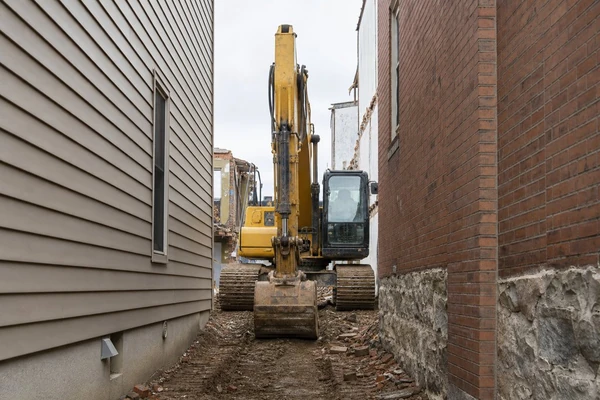
Heavy demolition equipment
Dust changes everything. If there is a tight entry/exit, there’s a possibility of damaging sidewalks or parking areas. Gaining access to a tight residential area can mean damage to landscaping, trees, and gateways. There are other things to consider for a confined space, which is why planning is so critical to success.
Demolition can be contentious in its own right. Neighbors, especially ones with adjoining driveways, shared walls, or closely-set properties, might raise concerns about temporary vibration, noise, and access to the project site. Photograph any adjoining buildings or shared structures before commencing work. Open lines of communication with neighbors, and take detailed photographs before starting work.
Before scheduling your project, check in to make sure that you have all permits, inspections, and neighborhood requirements. Miami may have rules regarding working hours, using the right-of-way, protecting trees, controlling dust, or setting up a dumpster for debris.
Put the Demolition Scope in Writing
It’s a good idea for the owner and contractor to walk the area and make sure each party has a clear vision of the project. It’s always a good idea to get your scope in writing from the contractor before beginning any work. Demolition is a very particular and specialized part of the construction process, which is why it’s important to understand the process and costs involved; the practical side of demolition services Miami starts there. A company called Gaven Constructions works in this specialized field. Here are a few terms and definitions:
- Hand Demolition: Demolition with hand tools or by hand. Can be more expensive and take longer but provides a level of precision and dexterity that other methods don’t offer. This is also a great option if it’s not possible to remove the structure in occupied spaces.
- Mechanical Demolition: Using machines and heavy equipment, mechanical demolition can take out a structure or foundation very quickly. Depending on the scope, it may require additional planning for dust control and containments.
- Deconstruction: If there’s an opportunity to reuse material and components from the structure, this is where the wood, doors, fixtures, and fittings are saved for future uses. These materials are removed before large scale demolition can occur.
- Concrete Breaking: Concrete driveways, footings, foundations, and other elements require special tools to break and remove. If your site has reinforced concrete slabs or foundations, this is a service to keep in mind.
- Debris Removal and Cleanup: After the project is complete, it’s helpful to sort and separate recyclable and salvageable materials before hauling. Concrete, metal, drywall, and wood can all be separated on site to limit the amount going to the land fill. Hazardous and regulated materials are also removed for proper disposal.
- Site Stabilization: After demolition and debris removal, we make sure the area is stable and safe for whatever comes next. Nails and sharp pieces are removed or capped. Loose materials and sediment that could enter water runoff are also removed. Any materials that are remaining after demolition will be inspected and stabilized.