
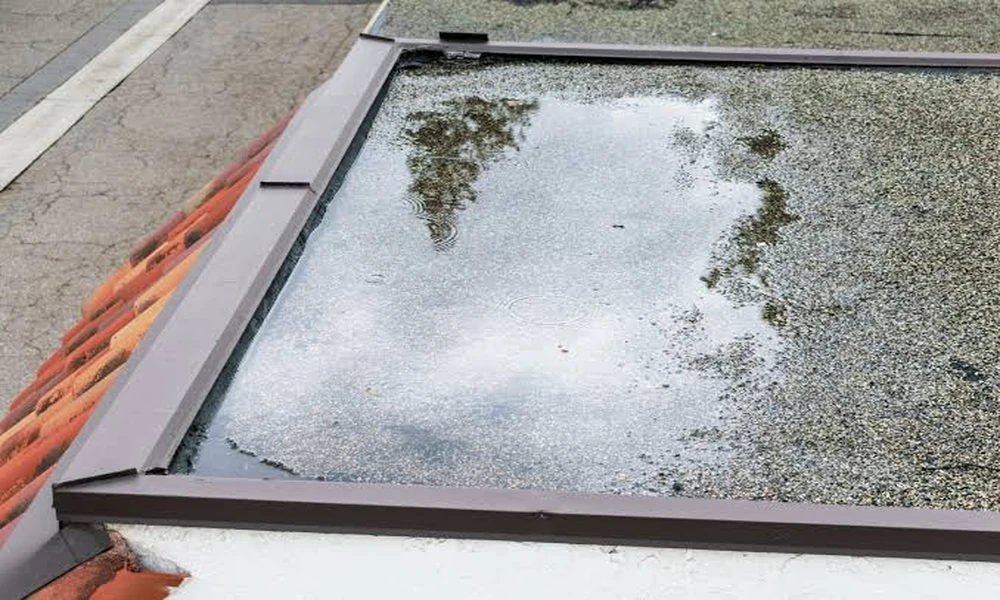
A flat roof is rarely flat for long. Decks sag a little, drains clog with leaves, and water settles in low spots nobody planned. How a membrane responds to standing water decides how often you call for repairs, and often how long the roof lasts, more than the number on a spec sheet.
The Piedmont Triad sharpens the question. In one June summary, the NC State Climate Office reported that Piedmont Triad Airport received 9.94 inches of rain, its third wettest June since 1903. Storms like that arrive on top of hot summer afternoons, so water and roof heat hit the same membrane in the same week. Below, TPO, EPDM, PVC and silicone coating are compared on lifespan, repair, heat, ponding water and installed cost.
Mid Atlantic Roofing Systems is a Winston-Salem contractor and an authorized Carlisle SynTec applicator. Its crews install TPO, EPDM, PVC and silicone coating systems on commercial and flat roofs across Forsyth and Guilford counties. Because one company handles all four options, a quote can weigh them against your own drain layout, insulation condition and budget instead of steering you toward a single product.
What each system is and how it gets repaired
TPO (thermoplastic polyolefin): A white, heat welded single ply sheet. Hot air fuses the seams into the membrane itself, and repairs mean cleaning the spot and welding on a patch. Quality depends heavily on the crew, because a poorly welded seam is the classic TPO failure point. Lifespans of 20 to 30 years are commonly quoted.
EPDM (ethylene propylene diene monomer): A synthetic rubber sheet in black or white, with the longest track record of the four. Carlisle introduced its Sure-Seal EPDM in 1961. Seams use tape or adhesive, and small repairs are quick patch and primer jobs. It stays flexible in cold weather, which suits Piedmont freeze and thaw cycles.
PVC (polyvinyl chloride): Heat welded like TPO, but formulated to resist grease, oils and chemicals. That is why it turns up over restaurant kitchens and manufacturing plants. Its welded seams are very strong, and patching is a welding job. It costs more up front, and the premium pays off where exhaust or runoff would break down other membranes.
Silicone coating: Not a membrane at all. It is a liquid applied over an existing roof that cures into a seamless, waterproof skin. Repairs are spot recoats on a clean, dry surface. It extends a roof that is basically sound, but it cannot rescue wet insulation or a failing deck.
Where ponding water and heat separate them
Ponding water: Silicone is the most forgiving, because cured silicone tolerates standing water. That is why it is often chosen to restore low slope roofs that drain slowly. TPO and PVC have fully fused seams, while EPDM relies on tape or adhesive, but all three membranes do best when water clears within a day or two. Manufacturer warranties often cap how long water may stand, so confirm the current terms. The better fix is usually drainage: tapered insulation, crickets or an added drain.
Heat: White TPO and PVC reflect most sunlight, and EPDM comes in white too, but black EPDM absorbs heat and raises cooling loads in summer. Reflectivity also fades. A Berkeley Lab analysis of Cool Roof Rating Council data found that field applied coatings, modified bitumen and single ply membranes lost the most solar reflectance over three years, while factory applied coatings and metal lost the least. A bright white silicone coat starts cool and then dirt dulls it. Ask for the aged rating, not the initial one. Carlisle notes that all of its single ply membranes are listed in the CRRC directory, so the numbers are easy to check.
Installed cost and lifespan side by side
| System | Typical lifespan | Repair method | Heat behavior | Ponding tolerance | Installed cost per sq ft |
|---|---|---|---|---|---|
| TPO | 20 to 30 years | Welded patch | White, reflective | Moderate, seams fused | $4 to $9 |
| EPDM | 20 to 30 years | Tape or adhesive patch | Black absorbs heat, white available | Moderate, taped seams | $4 to $10 |
| PVC | 20 to 30 years | Welded patch | White, reflective | Moderate, seams fused | $6 to $12 |
| Silicone coating | 10 to 20 years, recoatable | Spot recoat | Reflective, dulls with dirt | Highest | $5 to $7, restoration only |
These ranges vary with tear-off, insulation, roof access and the number of penetrations. The silicone figure is a coating on a sound roof, not a replacement. One coating manufacturer’s restoration estimates put a silicone recoat at $5 to $7 per square foot against $12 to $18 or more for a full tear-off. If the existing insulation is wet, the cheaper path is a false saving.
Matching the system to the roof
Choose TPO when: You want a reflective, mid priced membrane for a warehouse, retail center or office roof with decent drainage and a crew you trust to weld well.
Choose EPDM when: Budget and a long service record matter most, the roof sees cold snaps, and you can live with a black surface or pay for white.
Choose PVC when: Grease, oils or chemical exhaust reach the roof, or you want the strongest welded seams and will pay more for them.
Choose silicone when: The membrane is aging but dry underneath, water lingers in low spots, and restoring beats tearing off.
If the roof ponds water for days at a time, address the slope or drains before you pick a membrane. Whichever system you choose, it should hold up to the first heavy July storm.

Comments are closed.