
Walk through the Central Business District and you will see more than glass and steel. You are looking at strategy in built form. Every office tower, every mixed-use commercial block, every business park campus represents a series of calculated architectural decisions.
In Singapore, commercial real estate is not forgiving. Land is limited. Regulations are strict. Tenants are demanding. A poorly designed office building does not just look inefficient. It underperforms financially.
That is why serious developers engage Singapore architects who understand more than aesthetics. They understand yield, compliance, tenant psychology, and long-term asset value. Let’s unpack what that really means.
Commercial Architecture Is Not Residential Scaled Up
Designing a landed house and designing a commercial tower are fundamentally different disciplines. One prioritises lifestyle and privacy. The other prioritises efficiency, compliance, and return on investment.
Singapore architects handling commercial and office developments must optimise net lettable area while maintaining regulatory compliance. They balance structural grids with flexibility so future tenants can configure layouts efficiently.
This is architecture driven by metrics, not just mood boards.
Understanding Plot Ratio and Development Potential
In Singapore, commercial development is tightly governed by URA’s Master Plan. Plot ratio determines how much floor area you can build relative to land size.
Maximising allowable gross floor area without breaching height and setback limits requires precise design coordination.
Singapore architects play a critical role at feasibility stage. They evaluate development potential before acquisition decisions are finalised. A small miscalculation in plot efficiency can translate into millions in lost leasable area.
This is where strategic architecture begins.
Office Design Is About Productivity
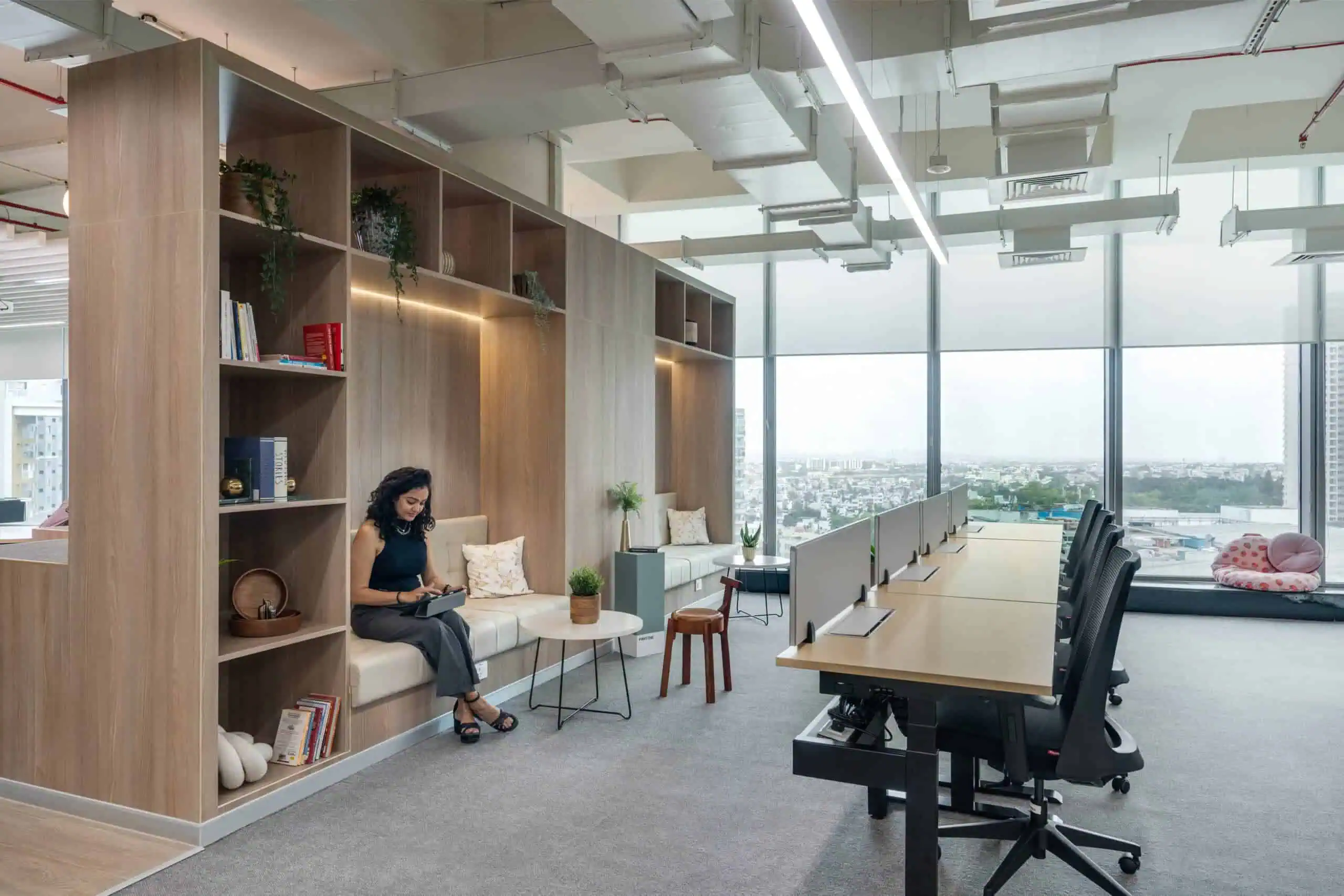
Modern office tenants do not just want floor space. They want environments that support collaboration, flexibility, and employee wellbeing.
Singapore architects integrate column spacing, ceiling height, daylight penetration, and mechanical system placement to enable adaptable interior layouts.
High floor-to-ceiling heights improve spatial perception. Efficient core placement maximises usable space.
Design decisions directly influence tenant satisfaction and retention.
Sustainability Is No Longer Optional
Commercial buildings in Singapore face increasing sustainability expectations. BCA Green Mark certification is not a bonus. It is often a baseline requirement.
Energy efficiency, water conservation, and low-carbon material selection influence design from day one.
Singapore architects integrate passive shading, high-performance facades, and efficient building systems to meet Super Low Energy benchmarks.
Sustainability is not just regulatory compliance. It is tenant attraction strategy.
Façade Design in a Tropical Climate
Singapore’s climate demands intelligent facade strategy. Excessive glass without shading increases cooling loads dramatically.
Commercial buildings must balance transparency with heat gain control.
Singapore architects design facade systems using vertical fins, double glazing, and strategic shading devices to reduce energy consumption.
A good facade is not about looking modern. It is about performing efficiently in humidity and heat.
Mixed-Use Developments and Integration
Many commercial projects in Singapore are mixed-use, integrating retail, office, and sometimes residential components.
Singapore architects coordinate circulation, service access, and fire safety compliance across different occupancy types.
Vertical transportation systems must be separated appropriately. Acoustic performance between retail and office zones must be managed carefully.
Mixed-use design requires layered coordination.
Authority Submissions and Regulatory Navigation
Commercial developments face more complex submission requirements than residential projects.
Planning approval from URA, building plan endorsement by BCA, fire safety clearance from SCDF, and sometimes environmental impact assessments may apply.
Singapore architects prepare and coordinate all submissions, ensuring documentation aligns with statutory standards.
Regulatory fluency prevents costly redesign during approval stages.
Structural Coordination and Column Efficiency
Office buildings depend heavily on structural efficiency. Column placement determines usable floor area and tenant flexibility.
Singapore architects collaborate with structural engineers to optimise column grids. Wide spans increase flexibility but require stronger structural solutions.
Balancing material cost with space optimisation becomes a core design challenge.
Well-coordinated structure increases long-term leasing appeal.
Core Placement and Vertical Circulation
Lift core placement affects both efficiency and tenant experience.
Central cores maximise perimeter daylight. Offset cores may increase flexibility depending on site configuration.
Singapore architects evaluate vertical transportation needs based on building height, occupancy load, and peak traffic modelling.
Poorly designed core layouts result in congestion and inefficiency.
Construction Cost and Phasing Strategy
Commercial developments are capital-intensive. Cost control is essential.
Singapore architects work alongside quantity surveyors to benchmark construction budgets early. Design decisions such as facade complexity and material selection influence cost significantly.
For larger projects, phased development strategies may be required to manage financing and market absorption.
Strategic phasing reduces financial exposure.
Adaptive Reuse of Commercial Buildings
Not every project starts with vacant land. Some developers reposition aging commercial buildings through adaptive reuse.
Singapore architects evaluate structural capacity and regulatory compliance before proposing refurbishment strategies.
Upgrading facade systems, improving energy efficiency, and reconfiguring internal layouts can extend asset lifespan without demolition.
Adaptive reuse is increasingly attractive in sustainability-driven markets.
Tenant Customisation and Fit-Out Coordination
Commercial tenants often require custom interior fit-outs.
Singapore architects design base building infrastructure to accommodate varying tenant requirements.
Raised flooring systems, modular partitions, and flexible mechanical layouts enable easier tenant adaptation.
A building that supports flexibility attracts a wider tenant pool.
Risk Management in Commercial Projects
Commercial construction involves financial, regulatory, and market risks.
Singapore architects mitigate risk through rigorous documentation, design coordination, and authority engagement.
Clear contract scopes and consistent site supervision reduce variation claims and disputes.
Professional oversight protects both schedule and budget.
Long-Term Asset Positioning
Commercial architecture is ultimately about asset value.
Buildings designed with sustainability, flexibility, and operational efficiency command stronger rental rates and investor interest.
Singapore architects who understand commercial strategy design buildings that remain competitive decades after completion.
Design quality and financial performance are not separate. They are interconnected.
Final Thoughts
Commercial and office developments in Singapore operate at the intersection of design, finance, and regulation.
Engaging experienced Singapore architects ensures your project maximises development potential, meets sustainability standards, and appeals to modern tenants.
In a city where land is scarce and expectations are high, architecture is not decoration. It is performance. And in commercial real estate, performance defines success.

Comments are closed.